Should Your Studio Offer a Restorative Yoga Certification?
Jun 26, 2026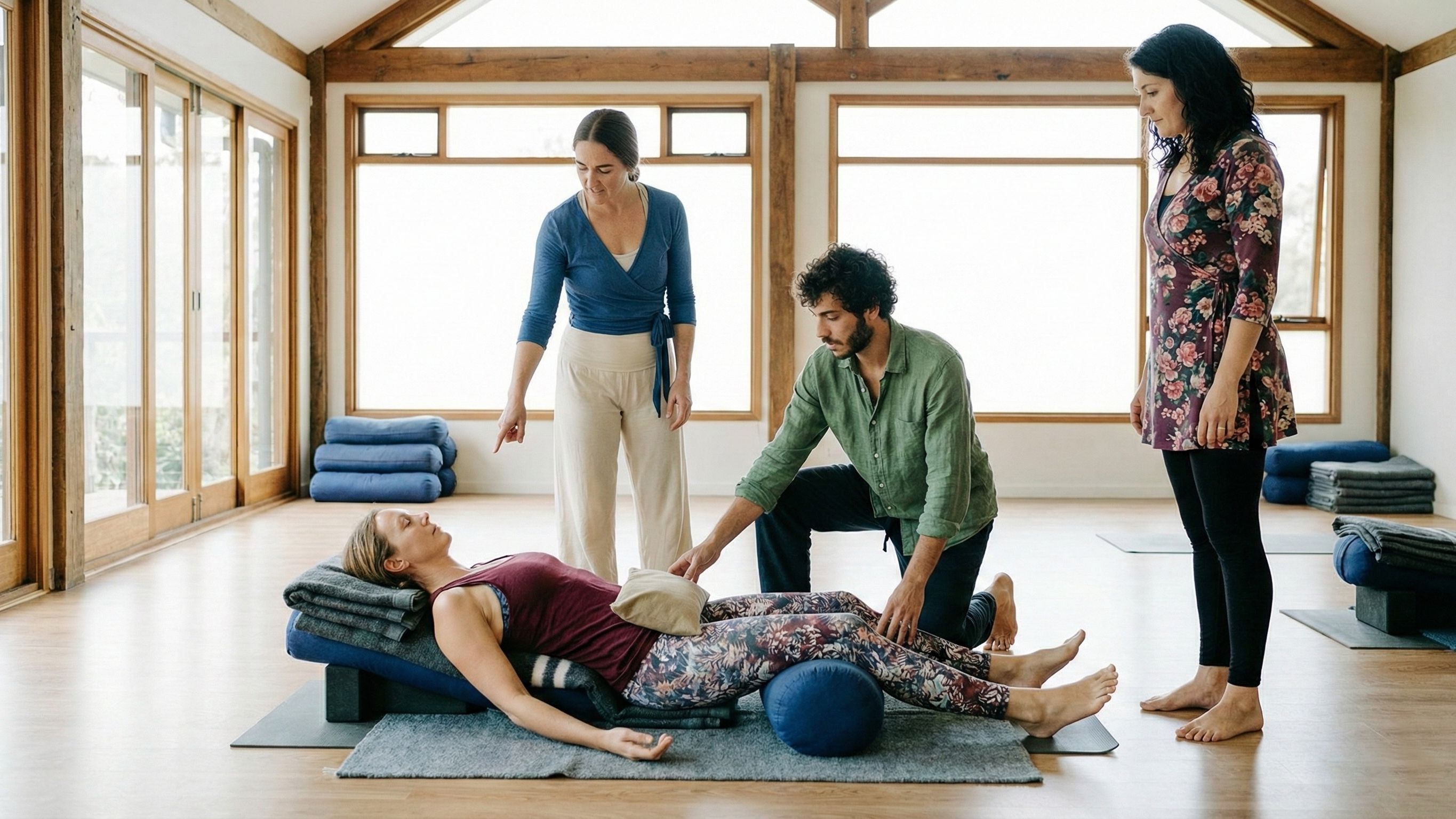
Restorative yoga has moved steadily from the fringes of yoga culture toward the centre of many practitioners' lives. For experienced teachers, it represents a different mode of understanding the practice entirely: slower, more deliberate, oriented toward the nervous system rather than the musculoskeletal system. For students managing stress, chronic illness, or the aftermath of trauma, it can be the most important thing a yoga teacher offers them.
For studios already running yoga teacher training, the question of whether to add a restorative certification arrives at an intersection that deserves careful thought. It is not simply a question of whether there is appetite for the programme. The more useful questions are whether this is what your community genuinely needs, and whether your school can deliver it with the depth it requires.
What a restorative certification is actually offering
The first thing worth understanding is that restorative yoga teaching is not simply yoga delivered more slowly, or an easier version of what teachers already know. It is a specific set of practices grounded in a distinct understanding of how the nervous system functions and how the body releases accumulated tension when given full support.
A restorative practice, taught well, is designed to activate the parasympathetic nervous system. This involves understanding how the body moves through states of sympathetic arousal and what conditions facilitate genuine downregulation. Prop use in restorative yoga is purposeful and specific: it is not decoration, and it is not interchangeable. Choosing which props support which posture, and understanding why a given arrangement serves a particular physiological function, requires genuine knowledge of both anatomy and nervous system science.
This is why a restorative certification with real substance covers considerably more than prop placement. It covers the science of the autonomic nervous system, the rationale behind sequencing decisions, contraindications and modifications for students with injuries or chronic conditions, and the facilitation skills specific to this modality, which differ meaningfully from the skills involved in leading a dynamic class.
Who this training is designed for
A restorative certification is not a beginner's introduction to yoga teaching. It is designed for people who already have a foundation: experienced yoga practitioners, teachers who want to offer restorative classes as part of their teaching repertoire, and graduates who want to deepen significantly in this area of practice.
Increasingly, it is also sought by teachers already working in therapeutic or trauma-adjacent contexts, teachers working in hospital wellness programmes, aged care, rehabilitation settings, or with clients who have complex health histories. For those teachers, restorative training is not an add-on credential. It is a core competency for the work they are already doing.
Understanding who your programme is designed for should shape the curriculum, the scheduling, the cohort size, and the language you use to describe it. A programme that tries to be everything to everyone in this space tends to do justice to none of them.
What genuine quality looks like
The question most worth asking when designing or evaluating a restorative certification is: will graduates finish this programme with a genuinely deepened understanding of the practice, or will they finish with a checklist?
Quality in a restorative certification means students leave able to sequence a restorative class with clear physiological reasoning, to adapt that class for students with specific presentations, to recognise when a student's nervous system is not responding as expected, and to understand the principles well enough to make good decisions in situations the curriculum did not specifically anticipate.
It also means meaningful engagement with the intersection of restorative practice and trauma-informed teaching. The populations most likely to seek restorative yoga, those with trauma histories, chronic stress, or conditions involving nervous system dysregulation, are exactly the populations for whom a teacher's understanding of consent, pacing, and safe facilitation matters most. A restorative certification that does not address this intersection is incomplete.
Trainer qualifications
This is perhaps the most important practical question for any school director considering a restorative programme. What level of expertise does a trainer need to credibly offer this training?
Holding a certificate in restorative yoga is a starting point, not a qualification. The trainers best placed to lead a restorative certification are those who have practised and taught restorative yoga across a range of populations over years, who have studied with senior practitioners in the field, and who have enough experience to respond to what actually happens in the room rather than following a script. That depth of experience is not something that can be acquired quickly, and schools should be honest with themselves about whether their current faculty meet that standard.
If they do not, the question becomes whether to develop that expertise over time, or to engage an external specialist trainer with genuine credentials in this area, and to think carefully about what that means for how the programme is structured and sustained.
Operational realities
Restorative yoga teacher training has practical requirements that differ from a standard teacher training environment. The practice requires substantial physical space per student: bodies horizontal, surrounded by bolsters, blankets, blocks, and props, cannot be arranged in the tight rows that work for an asana class. Prop storage is a genuine operational consideration.
Cohort sizes for quality restorative work are typically small. This is not a limitation to manage around but a pedagogical feature: hands-on learning, close observation of how students settle into postures, and individualized feedback all require the trainer to have genuine access to each participant. A cohort of eight to twelve is common for this reason.
Scheduling format matters too. Restorative intensives work well over a weekend or spread across several evenings, allowing participants to integrate each session before moving to the next, which itself reflects the pedagogy of the practice.
The question worth sitting with
Before committing to a restorative certification, the question most worth asking is not whether the programme will attract participants. The more honest question is whether your school can deliver a restorative training that graduates will look back on, years later, as having genuinely deepened their understanding of the practice and their capacity to serve their students.
That is the standard restorative yoga deserves, and it is the standard participants in this space are increasingly able to recognise. For school directors working through these questions, Yoga Training Resources offers curriculum materials and guidance developed with that standard in mind.